Stop Spot-Treating Your Breakouts: What Vietnamese Herbalists Have Known About Acne for Centuries
Let's be honest: the American approach to acne is basically a war. You see a pimple, you nuke it. Benzoyl peroxide, salicylic acid, retinoids — the artillery is impressive, and sometimes it works. But if you've ever cleared one breakout only to watch three more pop up a week later, you already know something isn't adding up.
Vietnamese dermatologists and traditional herbalists would tell you the problem isn't your skin. It's the strategy.
Acne as a Body Problem, Not a Face Problem
In Vietnamese traditional medicine — rooted in the same philosophical framework as Traditional Chinese Medicine but shaped by centuries of distinct regional practice — acne has never really been a skin condition. It's a symptom. The skin is treated as a mirror reflecting what's happening inside: digestive imbalances, excess internal heat, hormonal fluctuation, or a liver under stress.
This framing might sound abstract, but it maps surprisingly well onto what modern research is starting to confirm. The gut-skin axis is now a legitimate area of dermatological study, with researchers finding real links between gut microbiome health, inflammation markers, and acne severity. Vietnamese herbalists weren't working with that vocabulary, but they were working toward the same conclusion — that clearing skin means addressing the whole system.
Western dermatology, by contrast, developed around a model of acne as a localized bacterial and sebum problem. Kill the bacteria (C. acnes), reduce the oil, unclog the pore. That logic produced benzoyl peroxide and salicylic acid, which genuinely help a lot of people. But they also strip the skin barrier, disrupt the skin's natural microbiome, and do essentially nothing for the internal triggers driving new breakouts. You're winning battles while losing the war.
Bitter Melon: The Ugly Vegetable With a Gorgeous Track Record
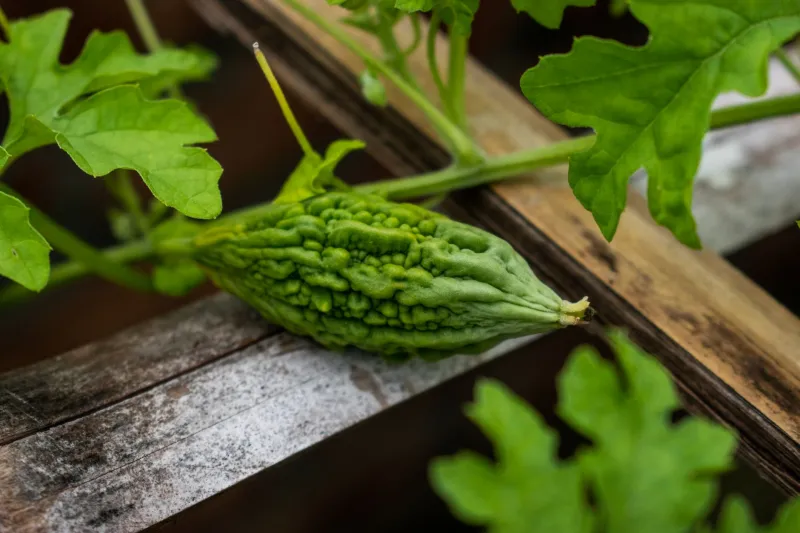
If you've ever wandered through a Vietnamese grocery store and spotted that gnarly, bumpy green vegetable that looks like a cucumber went through something traumatic, that's bitter melon — khổ qua in Vietnamese, Momordica charantia in the lab. It's a staple in Vietnamese cooking and traditional medicine, consumed as a vegetable, brewed as a tea, and applied topically in various preparations.
For acne, bitter melon works on multiple fronts. It has well-documented antimicrobial properties, meaning it can help manage the bacterial imbalances that contribute to breakouts. But more interesting is its role as an anti-inflammatory agent and a blood sugar regulator. That last one matters more than people realize — blood sugar spikes directly trigger sebum overproduction and hormonal cascades that fuel acne. Vietnamese healers have used bitter melon for "cooling" the body and clearing heat-related skin flare-ups for generations. Modern studies are now backing up that intuition with data showing its effect on insulin sensitivity and systemic inflammation.
You're not going to find bitter melon extract in your CVS spot treatment. But Vietnamese skincare brands, including several you'll find here at Oski Vietnam Beauty, are starting to formulate with it in ways that are genuinely exciting.
Centella Asiatica: The Ingredient That Bridges Both Worlds
By now, most skincare enthusiasts in the US have heard of centella asiatica — it's been having a serious moment in K-beauty and has crossed over into mainstream American routines. What often gets lost in the hype is that centella (rau má in Vietnamese) has been a cornerstone of Vietnamese skincare and folk medicine for far longer than the trend cycle has existed.
In Vietnam, rau má is consumed fresh in drinks, used in cooking, and applied to the skin for everything from wound healing to calming sun-damaged complexions. For acne specifically, its value lies in its ability to reduce inflammation, support barrier repair, and promote collagen synthesis without triggering further irritation. This makes it particularly useful for the kind of angry, inflamed breakouts that benzoyl peroxide tends to make worse before it makes better.
Vietnamese dermatologists often recommend centella-based preparations precisely because they work with compromised skin rather than stripping it further. It's a gentler philosophy, and for people who've experienced the peeling, redness, and sensitivity that come with aggressive Western acne treatments, it's a genuinely appealing alternative.
What the Research Is (Finally) Catching Up To
Emerging dermatological research is lending credibility to what Vietnamese herbalists have practiced intuitively. Studies on bitter melon's anti-inflammatory mechanisms, centella's wound-healing actives (asiaticoside, madecassoside), and the broader role of botanical antioxidants in regulating skin inflammation are accumulating fast. Researchers at institutions including the University of California and various Asian dermatology research centers have been examining plant-based acne interventions with renewed seriousness.
None of this means you need to throw out your salicylic acid cleanser tomorrow. But it does suggest that a more complete approach to acne — one that combines targeted topical care with ingredients that address internal inflammation and barrier health — is likely to produce better long-term results than the spot-treatment-and-repeat cycle most Americans are stuck in.
Building a Vietnamese-Inspired Acne Routine
So what does a Vietnamese-influenced approach actually look like in practice? A few principles worth borrowing:
Prioritize anti-inflammatory ingredients over aggressive exfoliants. Centella asiatica, licorice root, and green tea extract are workhorses in Vietnamese formulations for a reason. They calm the skin environment rather than aggressively disrupting it.
Consider what you're consuming, not just what you're applying. Bitter melon tea is available at most Asian grocery stores and is easy to incorporate. It's not a miracle, but it's a meaningful addition if internal inflammation is driving your breakouts.
Protect the barrier. Vietnamese skincare philosophy places enormous value on keeping the skin's protective layer intact. Using gentler cleansers, incorporating fermented ingredients that support the microbiome, and avoiding over-exfoliation are all part of this thinking.
Be patient with systemic approaches. The frustrating truth is that working from the inside out takes longer than drying out a single pimple. But the results tend to be more durable — fewer breakouts overall rather than a constant whack-a-mole situation.
American beauty culture rewards fast fixes. Vietnamese skincare tradition rewards understanding. If your skin has been stuck in a cycle of breakout, treat, repeat — it might be time to ask whether the problem is the approach, not the products.