The Brightening Ritual American Shelves Are Missing: How Vietnamese Beauty Achieves Radiance Without Vitamin C
The Vitamin C Obsession Is Real — But Is It the Only Way?
Walk into any Sephora or scroll through your TikTok feed for five minutes and you'll see it everywhere: vitamin C serums promising to erase dark spots, brighten dullness, and deliver glass-skin radiance in a matter of weeks. The marketing is convincing. The before-and-afters are compelling. And yet, a huge portion of people who try these products end up frustrated — dealing with irritation, that tell-tale yellow oxidation stain on their pillowcase, or simply skin that just doesn't respond the way the ads promised.
Meanwhile, Vietnamese women have been achieving genuinely radiant, even-toned complexions for centuries. Without the serums. Without the $80 amber bottles. And without any of the fuss.
So what's actually going on here? Is vitamin C overrated, or is Vietnamese beauty just working with a completely different playbook?
The honest answer is: a little of both.
Why Vietnamese Beauty Culture Never Leaned Into Vitamin C
Vitamin C as a skincare ingredient is a relatively modern Western obsession. The stabilized, high-concentration ascorbic acid formulas we know today didn't really hit the mainstream until the late 1990s and early 2000s. But Vietnamese skincare traditions stretch back hundreds of years — long before cosmetic chemists were solving oxidation stability problems in lab settings.
Traditional Vietnamese beauty was built around what was available: botanicals, fermented ingredients, natural minerals, and food-based remedies passed down through families. The goal was always the same — sáng da, or brightening the skin — but the methods were rooted in gentleness, patience, and working with the skin's natural rhythms rather than aggressively targeting pigmentation.
That philosophy matters. A lot of the irritation people experience with high-dose vitamin C comes from its acidity. Vietnamese skin traditions, by contrast, tend to favor ingredients that calm, nourish, and gradually encourage luminosity rather than forcing it.
Fermented Rice Water: The Original Brightening Toner
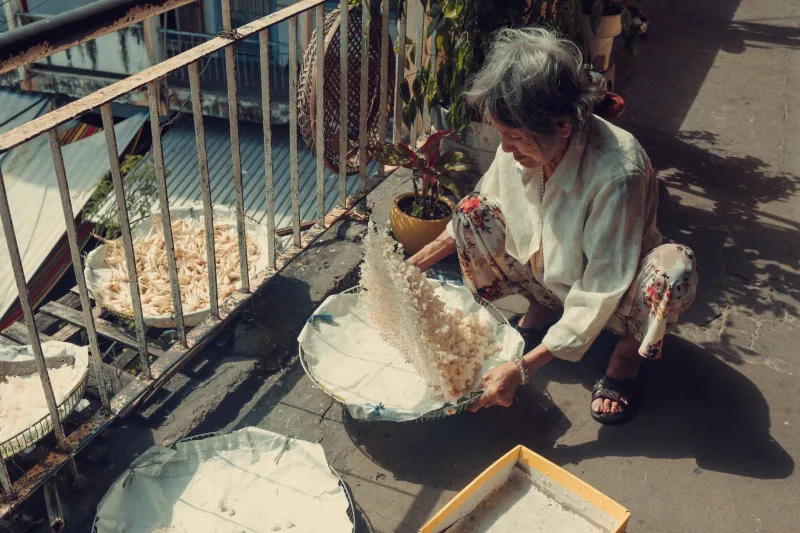
If there's one ingredient that anchors Vietnamese brightening culture, it's fermented rice water. This isn't just a trendy K-beauty export — Vietnamese women have been using it for generations, often made fresh at home from the rinsed water of cooking rice, left to ferment for a day or two.
The science behind it is actually pretty solid. Fermented rice water contains inositol, a carbohydrate that helps repair damaged skin and retain moisture. It also delivers ferulic acid — yes, the same antioxidant that Western cosmetic brands pay a premium to include in their vitamin C formulas to stabilize the serum. In its natural form, ferulic acid gently addresses oxidative stress and supports a more even skin tone without the pH-related irritation concerns.
The fermentation process itself matters too. It breaks down larger molecules into forms the skin can absorb more readily, and it introduces beneficial organic acids that lightly exfoliate and encourage cell turnover — again, gently.
Used consistently as a toner or a light rinse, fermented rice water doesn't deliver overnight drama. But over weeks and months, the results tend to be genuinely impressive: skin that looks cleaner, more even, and quietly luminous.
Pearl Powder: The Luxury Ingredient That's Actually Ancient
Pearl powder sounds like something a high-end spa brand invented to justify a triple-digit price tag. But in Vietnamese and broader Southeast Asian beauty traditions, it's been a staple for centuries — used both internally and topically to promote skin clarity and brightness.
Topically, pearl powder contains conchiolin, a protein that closely resembles the keratin in human skin. It also delivers calcium, magnesium, and amino acids that support skin cell regeneration. The brightening effect is thought to come from its ability to reflect light at the skin's surface while simultaneously encouraging the turnover of dull, uneven skin cells.
Modern research is still catching up to traditional knowledge here, but early studies suggest that pearl powder does have measurable antioxidant activity and may inhibit melanin production — which is exactly what you want from a brightening ingredient.
Unlike vitamin C, pearl powder is inherently stable. It doesn't oxidize. It doesn't turn orange on your shelf. And for most skin types, it's remarkably well-tolerated.
Licorice Root and Job's Tears: The Unsung Brightening Duo
Two other ingredients that appear consistently in Vietnamese herbal beauty traditions deserve a mention here: licorice root (cam thảo) and Job's tears (ý dĩ, also known as coix seed).
Licorice root contains glabridin, a compound that's been studied extensively for its ability to inhibit the enzyme responsible for triggering melanin production after UV exposure. It's one of the more evidence-backed natural brightening agents out there — and it does its job without the potential for irritation that comes with stronger actives.
Job's tears, meanwhile, is a grain that's been used in Vietnamese traditional medicine for generations, both eaten and applied topically. It's rich in proteins, fatty acids, and coixenolide, and has a reputation for improving skin texture and tone over time. You'll find it in traditional beauty drinks and food preparations as much as in topical products — a reminder that Vietnamese beauty has always understood that what you put in your body matters as much as what you put on your skin.
The Massage Factor: Gua Sha Before Gua Sha Was a Thing
Here's something the ingredient conversation often misses: Vietnamese brightening traditions aren't just about what you apply to your skin. They're about how you treat it.
Facial massage has been a part of Vietnamese beauty rituals for a long time — not the trendy gua sha version you see all over Instagram (though that's a related tradition), but specific techniques focused on stimulating circulation and encouraging lymphatic drainage. The idea is simple: skin that has good blood flow and isn't bogged down by fluid retention looks brighter, more alive, and more even-toned.
A few minutes of upward facial massage incorporated into your cleansing or moisturizing routine can make a noticeable difference in how your skin looks — not because you've added another active ingredient, but because you've improved the underlying circulation that gives skin its natural glow.
What This Means for Your Routine
None of this is to say you should throw out your vitamin C serum if it's genuinely working for you. Ascorbic acid is a legitimate ingredient with real research behind it.
But if you've been chasing radiance with increasingly expensive serums and still not getting the results you want — or if your skin just doesn't tolerate the acidity — the Vietnamese approach offers a genuinely compelling alternative framework.
Start with fermented rice water as a toner. Look for products that incorporate pearl powder, licorice root, or coix seed. Add a few minutes of facial massage into your nightly routine. Be patient.
The glow that comes from this kind of approach isn't the aggressive brightness you get from a high-dose active. It's quieter, more sustainable, and honestly — more beautiful for it.